

Stages
Early Childhood Education
Children's House - Montessori
Ages 3 to 6
“
The first task of education is to stir up life, but leave it free to develop.
— Maria Montessori
The Children's House Montessori stage corresponds to the Second Cycle of Early Childhood Education.
It covers the ages of 3 to 6 years. During this period, children are in the phase of the ABSORBENT MIND. This means that, as Dr. Montessori explained, through their own Sensitive Periods (windows that the brain opens at this stage to acquire specific learning in an exceptionally intense way), if they are offered a prepared environment with the right stimuli, they learn naturally and, without realising it, absorb the world around them.
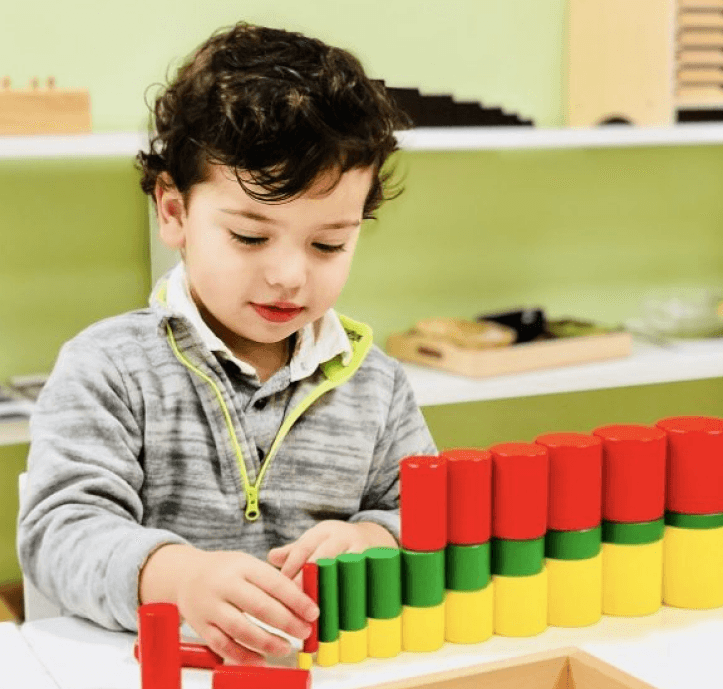
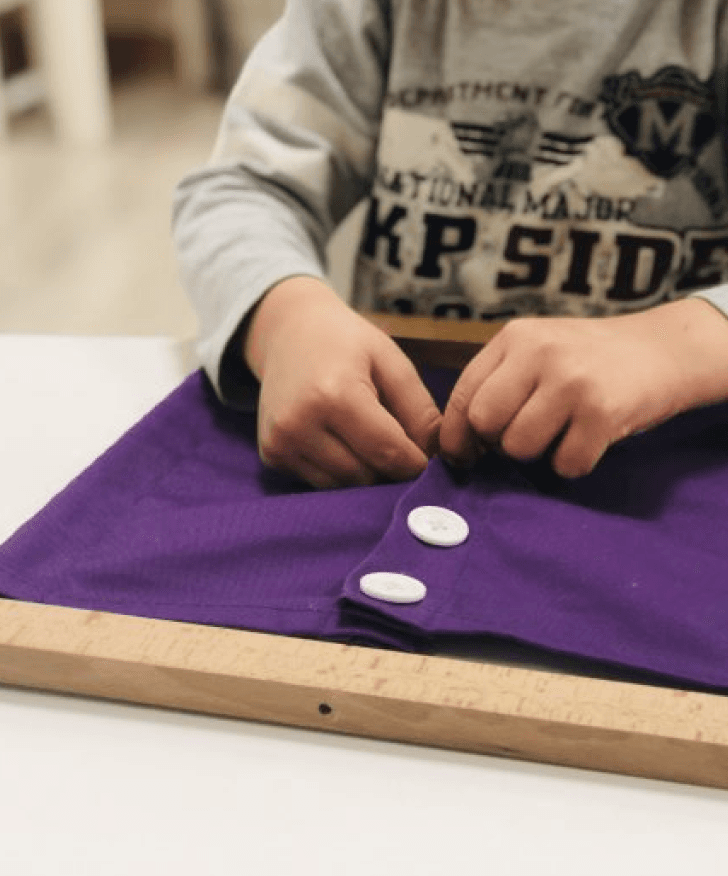
The main characteristic of the Montessori method is its deep understanding of Developmental Psychology.
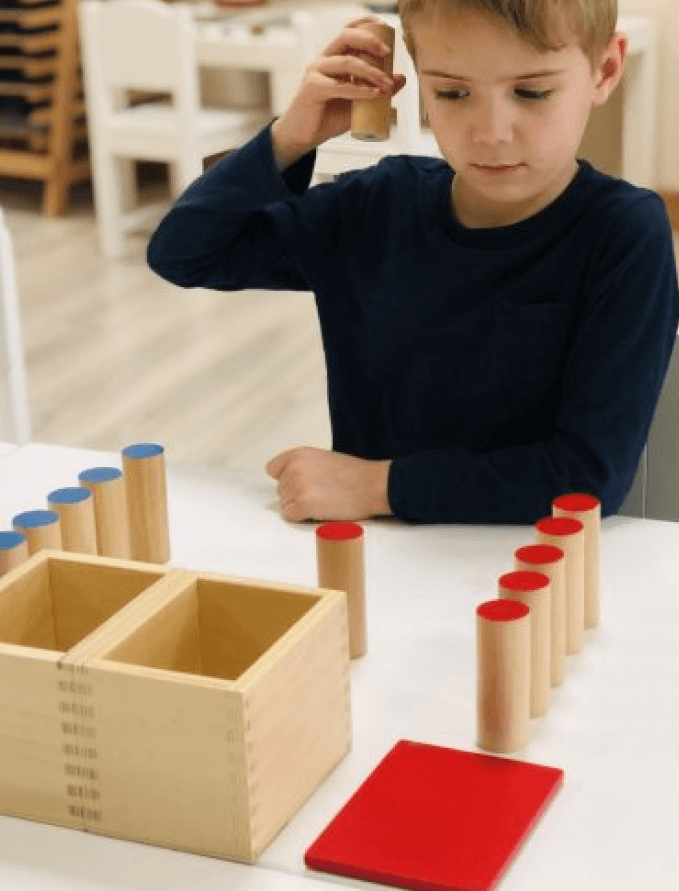
Its main reference is Dr. Jean Piaget, who in turn was a collaborator of Dr. Montessori. This demonstrates that a child's brain is not like an adult's but smaller; rather, it possesses different structures that evolve throughout development, and therefore must also learn differently depending on the stage they are in. Thus, the brains of children aged 3 to 6 must learn through hands-on manipulation and experimentation, and are not yet ready for intellectual or abstract learning — that is, they do not learn by doing worksheets. This does not mean that children of this age are incapable of doing worksheets — of course they can — it means that true learning and understanding comes through touch and the senses. For example, to work on the concept of quantity, a pupil can be asked to colour 2 apples on a worksheet and trace a dotted line representing the number 2, and they will probably do it well, but the child has not actually learned what it really means to have 2 things, unless they have 2 things in their hand and can count and touch them, in the same way that memorising the entire sequence of numbers: 1, 2, 3, 4… does not mean they understand what it is to have 4 things, but rather that they have simply memorised a series of words, which are the names of numbers.
Maria Montessori developed all the materials that bear her name, the foundation of her method.
HANDS-ON MATERIALS designed to capture the child's curiosity and guide them through their desire to learn. To achieve this goal, the materials are presented in groups according to their function. In general, all materials possess a more or less developed degree of four values: Functional, experimental, structural, and relational.
Another characteristic of Montessori materials is that nearly all of them are self-correcting, meaning that no task can be completed incorrectly without the child realising it themselves. An incorrectly completed task will have empty spaces or leftover pieces.
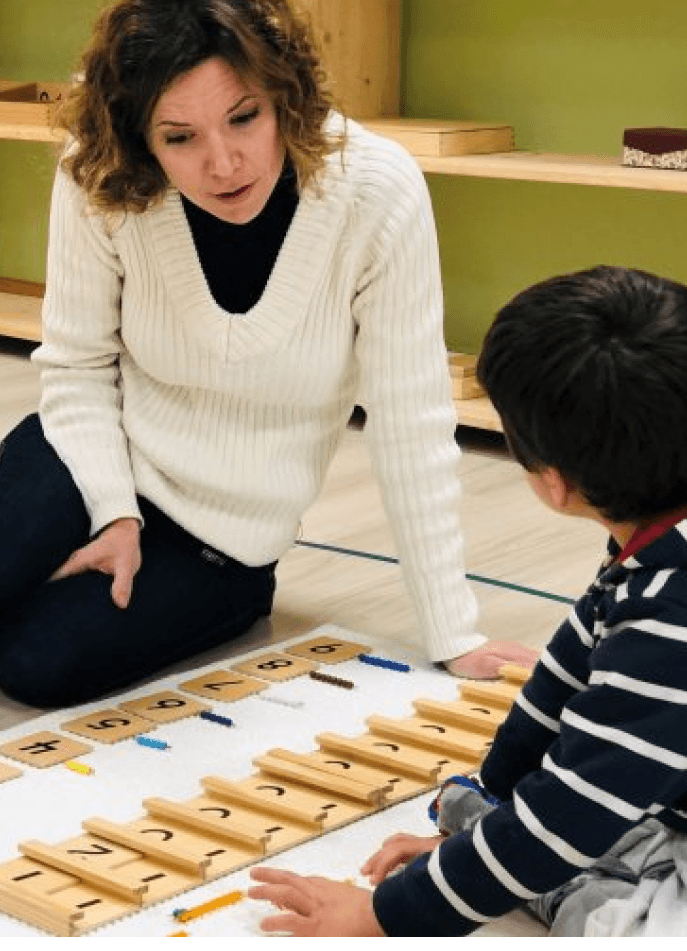
Most of the Children's House materials are presented to the child individually, ensuring that contact with each specific piece of knowledge takes place at the right time and at their own pace. This respects each pupil's individuality at a cognitive level, as well as the specific stage of their development, since children of these ages are still entering the so-called social stage and need a great deal of personalised contact and care. Hence the importance of continuous observation by the guides, and the low ratios at our school.
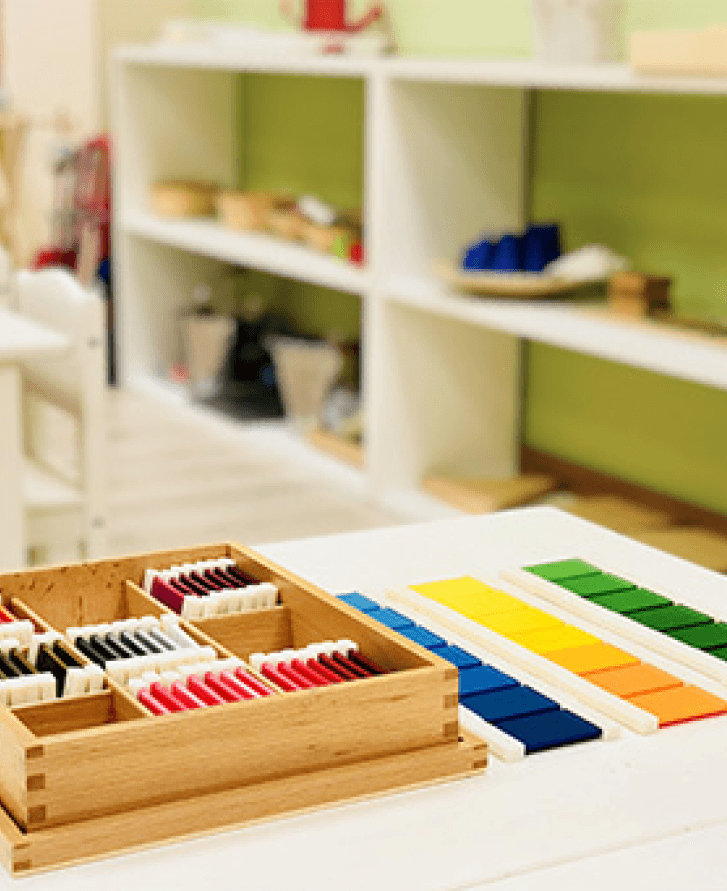
A Montessori classroom is also based on the principle of the PREPARED ENVIRONMENT.
This means it is organised into work areas equipped with tables adapted to the children's size, and open areas for floor work. Shelves are also provided where everything is within their reach, with materials belonging to each area of development, organised systematically and in order of difficulty. It is a design based on the principles of simplicity, beauty, and order, which, carefully organised by the adult, fosters the child's self-learning and growth. These work areas in the Children's House are five: Practical Life, Sensorial, Cultural Areas, Mathematics, and Language.
In the Montessori method, children are grouped in three-year age spans within the same classroom, in what are known as multi-level classrooms. In the Children's House, pupils aged 3, 4, and 5 share the same space, which provides them with undeniable benefits in their social, emotional, and cognitive development.
Another fundamental characteristic is the role of the adult as guide and observer. Through accompaniment, the adult conveys to the child the feeling of being capable of acting without constantly depending on the adult, expressing their creativity, curiosity, and ability to think for themselves.
What sets a Montessori school apart from a traditional one is not WHAT is learned, but HOW it is learned.
At Cuarto Creciente Montessori School, Children's House pupils come into contact with music, painting, psychomotor skills, and sensory experimentation through daily workshops within school hours, all of which takes place in a bilingual SPANISH/ENGLISH environment.
This is what makes the great difference that allows learning while enjoying and retaining naturally, so as not to forget what has been learned, nor to lose the innate desire to continue discovering the world around them, to preserve the self-esteem that makes them feel capable and happy. Solid foundations are therefore established to continue developing increasingly complex concepts ad infinitum.
Finally, we want to emphasise that the basis of this method is always self-discipline. It is important not to confuse respect for the child's rhythms with a lack of limits and permissiveness. The freedom the child has to explore the environment must always stem from having internalised respect for the other people they live with and the appropriate treatment of the materials they work with. In the words of Maria Montessori: 'To let the child do as they please when they have not yet developed the will is to betray the meaning of freedom'.
Primary Stage
Classroom - Montessori
Ages 6 to 12
“
The child who has freedom and opportunity to manipulate and use his hand in a logical way, with consequences and using real elements, develops a strong personality.
— Maria Montessori
In the Workshop I (6-9 years) and Workshop II (9-12 years) stage, children are in the second plane of development.
Corresponding to Primary Education, it is what Maria Montessori called the phase of the REASONING MIND.
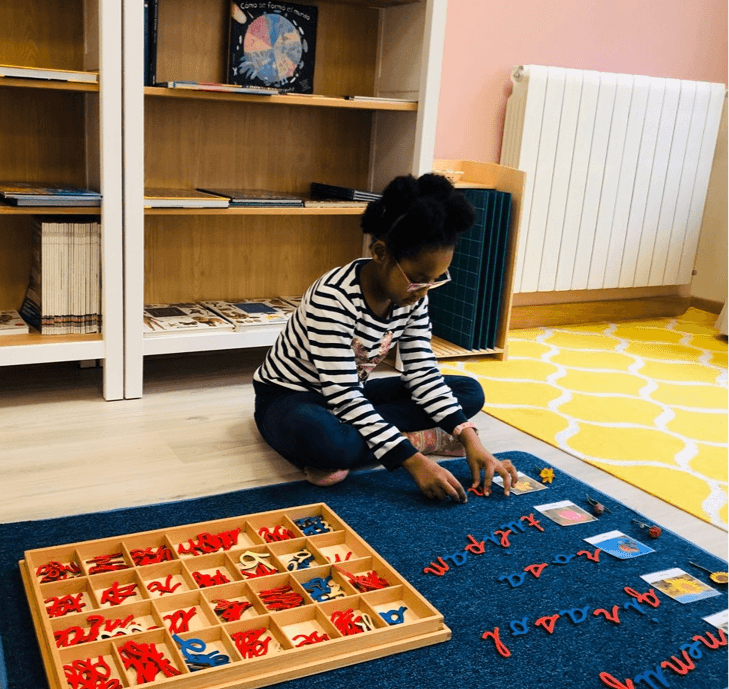
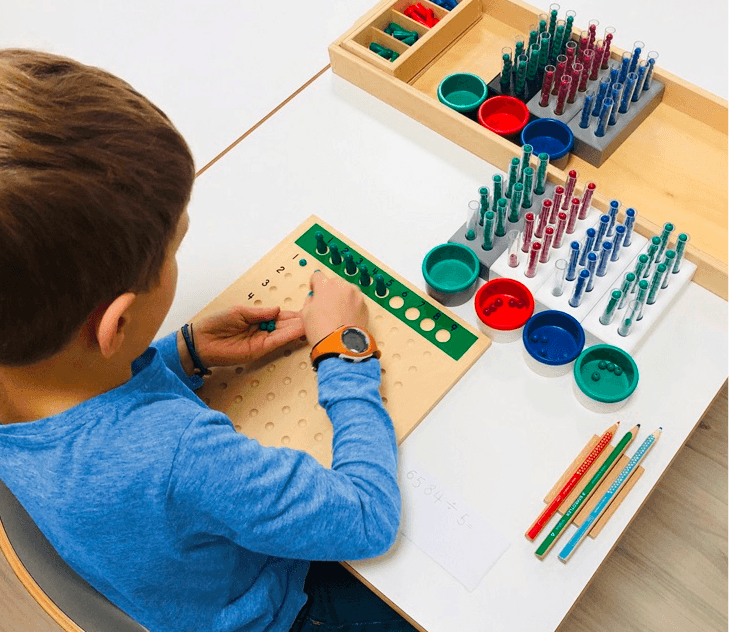
Children of these ages are characterised by a need for research and practical exploration.
By that curiosity that leads them to question everything and an intrinsic motivation to be the active subjects of their own learning. They also have greater awareness of what they find interesting, and their imaginative capacity increases if they are offered the right framework for their development.
Furthermore, boys and girls at this age tend to work collaboratively and cooperatively, which allows them to delve into a wide variety of projects, develop social skills such as assertiveness and empathy, and put into practice their own strategies for conflict resolution, thereby achieving great self-confidence. They thus acquire the mastery and integration of the cognitive, social, and emotional skills necessary to face the challenges of their present and future.
In the Montessori method, the stage corresponding to Primary Education is called Workshop.
Although the curriculum taught is the same as in a traditional school, the way in which knowledge is acquired in Montessori is very different, as pupils learn by constantly exploring and experimenting, as in a true workshop. They do not remain passive and seated in a fixed place, waiting for an adult to tell them which subject or task to address at any given moment; rather, the pupil decides and investigates with all the hands-on materials at their disposal, accompanied by the adult as a guide in their own learning. In this way, the educational environment and the school day are carefully organised and structured to ensure that all their needs are met.
For this reason, learning in the Workshop classrooms is also presented through a historical, evolutionary, and integrated vision of knowledge and human development. With a global approach, it allows the child to discover that everything they learn is interconnected, that these are not isolated contents within dry subjects in a curriculum, but interrelated parts that form a whole. They thus discover the holistic workings of the world around them, which affects them directly, and therefore everything they learn is of interest to them, setting their emotions in motion, which is fundamental, as neuroscience has shown us that emotion is the driving force of learning.
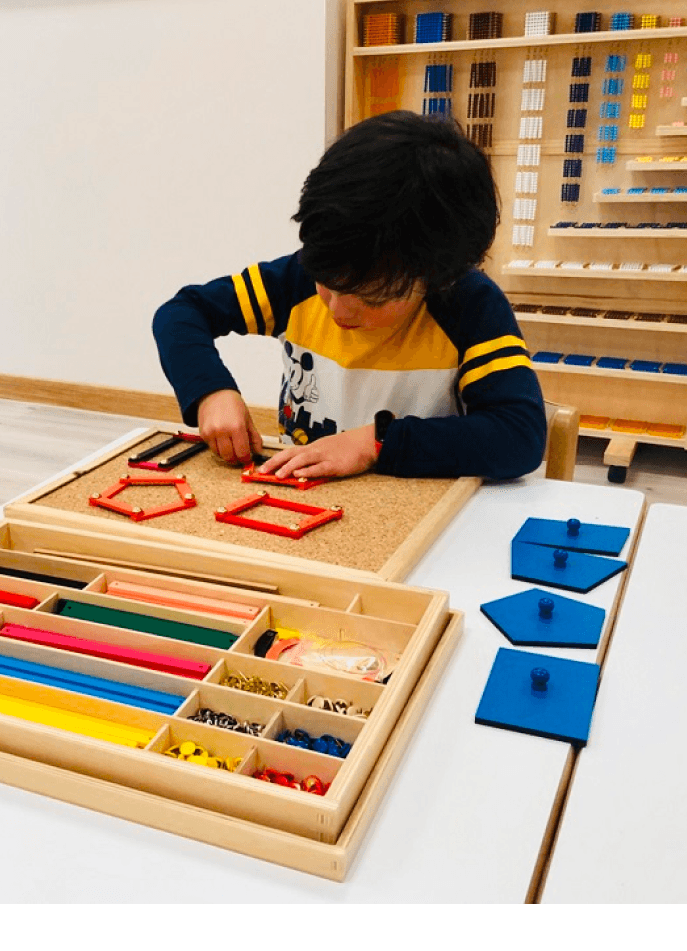
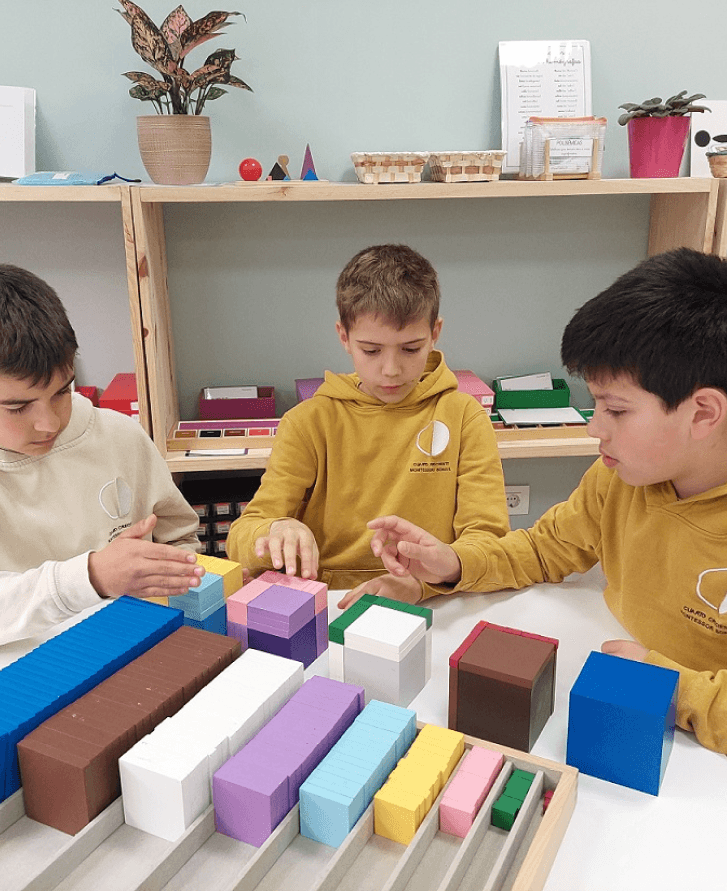
COSMIC EDUCATION is the foundation upon which learning is built in a Montessori Workshop environment.
Its purpose is to offer knowledge by inviting the pupil to develop the critical spirit of asking questions by appealing to their curiosity, and to foster the process of self-construction to develop individuals capable of contributing to creating a better world through ethical thinking. By working with the hands-on materials developed for pupils of these ages, knowledge is acquired in a natural way that ensures it is not forgotten.
Cuarto Creciente Montessori School also covers in this Primary Education stage, in line with the comprehensive development of each pupil, fundamental areas of development such as music, painting, garden work, and also sport every week at the Centro Deportivo Municipal Lobete, which is a five-minute walk from our school, all of which takes place in a bilingual SPANISH/ENGLISH environment.
Finally, we want to emphasise that the basis of this method is always self-discipline. It is important not to confuse respect for the child's rhythms with a lack of limits and permissiveness. The freedom the child has to explore the environment must always stem from having internalised respect for the other people they live with and the appropriate treatment of the materials they work with. In the words of Maria Montessori: 'To let the child do as they please when they have not yet developed the will is to betray the meaning of freedom'.